Shrimp
- Remove the female → the male will attack her to defend the nest
- The male tends the nest alone for 2–3 days until the eggs hatch
- Once the fry are swimming freely, remove the male as well
Breeding Setup:
- Shallow aquarium (maximum height of 25–30 cm—the fry cannot yet swim long vertical distances)
- Fern leaf/floating plant for the nest
- Low water level (20 cm) — the young come to the surface to breathe
- No filter (sucks up fry) — small partial water changes
SHRIMP BREEDING
Neocaridina davidi (Cherry Shrimp)
Process:
- When the female is ready, she performs a "molting dance" (she molts and releases pheromones)
- The males go wild and swim frantically in search of the female
- Fertilization Immediately After Molting
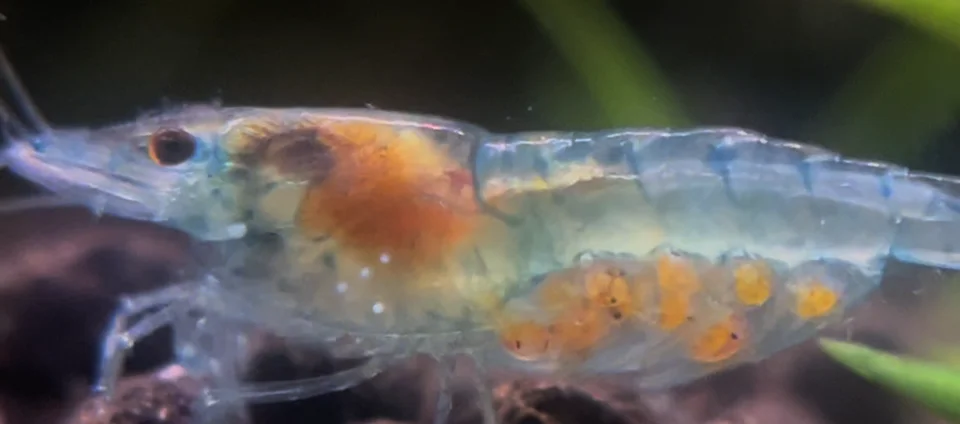
- The female carries the eggs under her abdomen for 3–4 weeks
- The young are born as tiny replicas of the adults
- They are independent from day one
Signal indicating imminent playback: The "saddle" (a dark spot on the female's back) becomes visible → these are the ovaries containing the eggs before fertilization.
Offspring:
- They don't need special food → they eat the natural biofilm in the aquarium
- Java moss as a refuge and source of biofilm
- With no fish to eat them
Caridina CBS/CRS
The process is the same as for Neocaridina, but with smaller broods (15–30 fry vs. 20–50 for Neocaridina). The female carries the eggs for 4–5 weeks.
REPRODUCTION OF SNAILS
Nerite
- Only in brackish water → non-invasive in freshwater
- The "white spots" that appear on the glass and decorations are egg capsules (they do not hatch in freshwater)
- To properly breed nerites, you need to transfer the eggs to brackish water (10–15 ppt) and then to 100% saltwater for the veliger larvae.