Filters
FILTERS
Types of Filtration
| Type | Mechanism | What it eliminates |
|---|---|---|
| Mechanics | Physical (sponges, cotton) | Suspended solid particles |
| Biological | Nitrifying bacteria | NH3, NO2 |
| Chemistry | Coal, resins, zeolite | Medications, tannins, phosphates, etc. |
All three types must be combined to create an efficient filter. Biological filtration is the most important for the health of the aquarium.
Indoor filters (submersible filters)
Sponge filter (airstone/sponge)
- How it works: An air pump creates a current through the sponge → mechanical + biological
- For: shrimp tanks, breeding, quarantine
- Pros: Doesn't suck up fry or shrimp, inexpensive, easy to clean
- Disadvantages: Insufficient fine mechanical filtration
Submersible box-type filters (HOB in-tank)
- Types: Tetra Brillant, JBL CristalProfi i
- For: Small to medium-sized aquariums
- Advantages: Easy to install, affordable
- Disadvantages: They take up space in the aquarium
HOB — Hang-On-Back (external hang-on filter)
- Types: AquaClear, Fluval C, Seachem Tidal
- For: Small to medium-sized aquariums
- Advantages: Takes up no interior space; very easy to maintain and modify
- Disadvantages: The water level must be correct; some models are noisy
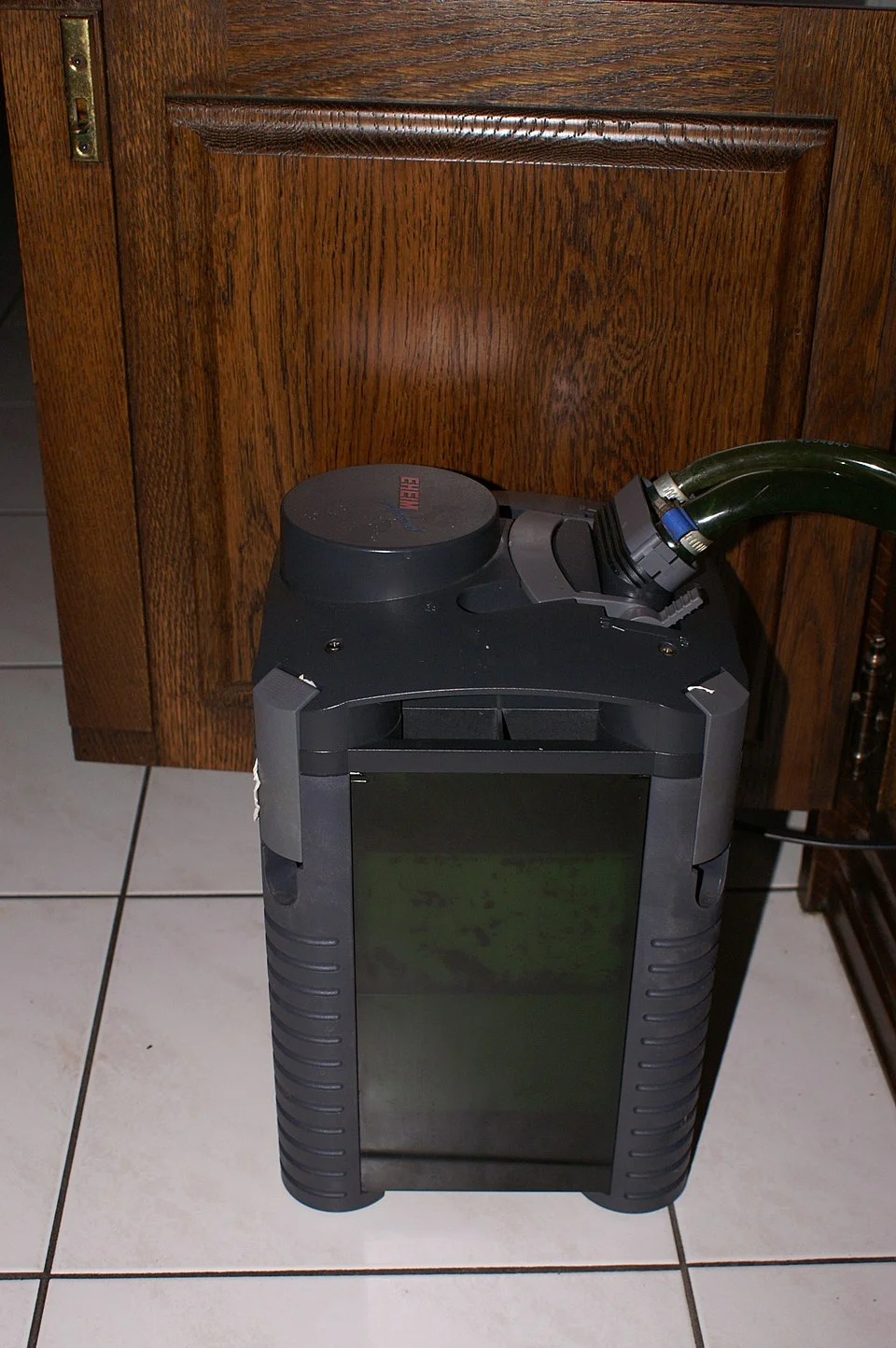
External (canister) filters
The standard for medium and large aquariums.
How it works: Water flows out of the aquarium through the intake tube → enters the canister from the bottom → rises through the filter media → is pumped back into the aquarium.
Advantages:
- High filter media capacity
- High biological efficiency
- Quiet
- It doesn't take up any space in the aquarium
Recommended models:
| Make/Model | Appropriate liters | Feature |
|---|---|---|
| Eheim Classic 350 | up to 350 L | The most reliable on the market—it lasts for decades |
| Eheim Experience/Pro | 100-600L | Automatic priming—very convenient |
| JBL CristalProfi e | 80-700L | Good value for the price |
| Fluval 07 Series | 100-500L | Easy maintenance |
| Oase BioMaster | 100-600L | Very convenient removable prefilter |
| AQUAEL Maxikani | 250-500L | Affordable, good performance |
Recommended filtration rate: 5–10 times the aquarium volume per hour (Example: 200-liter aquarium → 1,000–2,000 L/h filter)
Filter media
Mechanical (in order from coarse to fine, from inlet to outlet):
- Coarse sponge (blue) → traps large particles
- Fine sponge (white) → traps small particles
- Filter floss → traps very fine particles
Biologicals:
- Porous ceramic (Eheim Substrat Pro, Seachem Matrix): large surface area for bacteria
- Bioballs: rough surface, good aeration, good biological substrate
- K1 Media / Moving Bed: the most modern, constantly in motion → they never get clogged
- Lava rock / Volcanic rock: economical and effective, high porosity
Chemicals:
- Activated carbon: removes medications, tannins, and contaminants. DO NOT use continuously → allow it to regenerate
- Zeolite: captures ammonia. Use only during the initial cycle or in emergencies. No salt
- Phosphate resin (GFO): removes phosphates. Used in a reactor or in a bag
- Nitrate resin: rare, expensive
- Ion-exchange resins: for osmosis water
Protein skimmer (marine only)
What is it? It produces very fine air bubbles that carry dissolved organic matter and concentrate it in a collection cup. It removes proteins, fats, etc., before they decompose → preventing an increase in NO3 and PO4.
Types:
- Needle Wheel Skimmer: the most efficient, with the finest bubbles
- Counterflow-chamber skimmer: simpler, less efficient
Size: Always buy one that is rated for twice the volume of the aquarium → oversized = runs more smoothly and makes water extraction more effective.
Brands: Bubble Magus, Aqua Medic, Vertex, Nyos, Deltec (the best)
Refuge (Refugium)
A separate compartment from the main aquarium (inside the sump) where macroalgae (Chaetomorpha, Caulerpa) are cultivated. The algae absorb NO3 and PO4 and are harvested periodically (by removing the algae). It also serves as a habitat for copepods to feed finicky fish.
Sump
An additional tank located beneath the main aquarium, connected via an overflow. It houses the equipment (heater, skimmer, hiding place). It increases the total volume of the system → greater chemical stability.