Fish
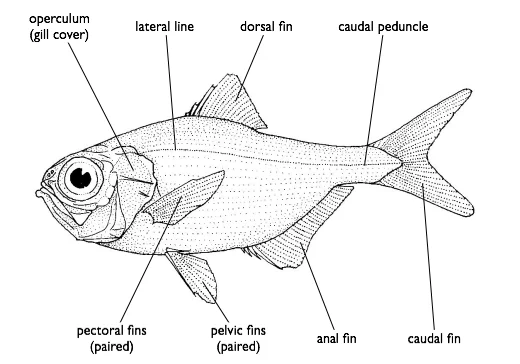
Basic Fish Anatomy
Major Systems
Integumentary system (skin and scales)
- Cycloid scales: smooth, rounded (carp, tetras, salmonids)
- Ctenoid scales: with teeth along the posterior edge (Perciformes, Cichlidae)
- Ganoid scales: hard, do not overlap (primitive fish: polypterids, spadefish)
- Scaleless: catfish (barbs, corydoras), eels
- The skin produces mucus that protects against pathogens and reduces friction
Respiratory System
- The gills exchange O2 and CO2 with the water
- Water flow: mouth → pharynx → gills → operculum
- Labyrinth fish (Betta, Gourami): a labyrinth organ that allows them to breathe atmospheric air
- Electric fish, lungs: Some species can breathe partially out of the water
Lateral system (lateral line)
- Detects vibrations and changes in water pressure
- Essential for moving in schools, detecting predators and prey
- It is damaged by contaminants, chlorine, and sudden temperature changes
Swim bladder
- Hydrostatic device that controls buoyancy
- When the gas flow is adjusted, the fish rises or sinks without swimming
- Problems: "swim bladder disease" — fish that swim on their sides or cannot submerge themselves
Digestive System
- Varies depending on the diet:
- Carnivores: short intestine, powerful stomach
- Herbivores: long intestine (to break down cellulose)
- Omnivores: intermediate