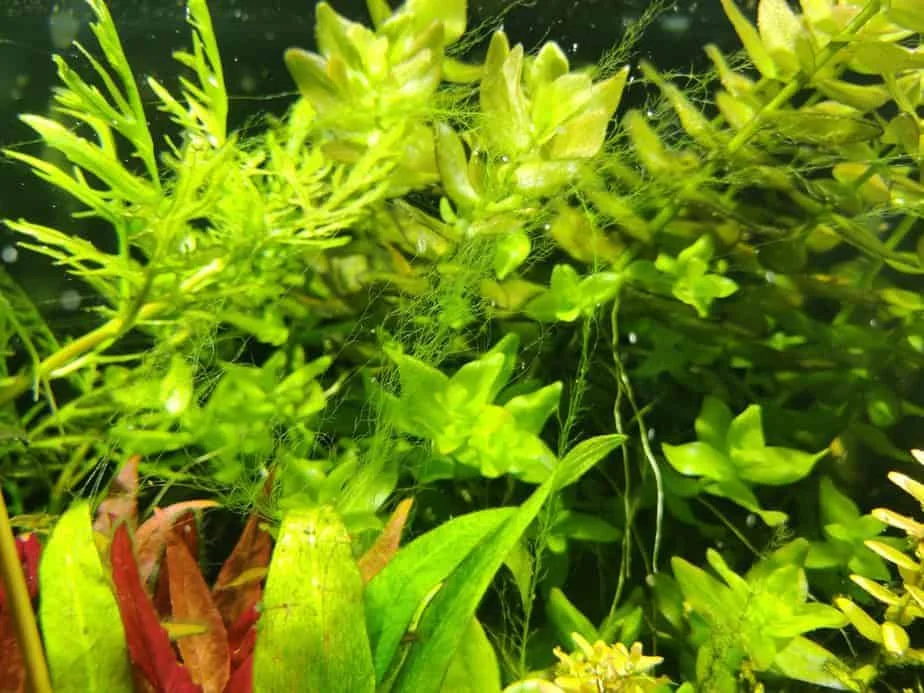
Gha
Green Hair Algae / Filamentous Algae (GHA — Green Hair Algae)
Scientific name: Cladophora sp., Spirogyra sp., Pithophora sp., Rhizoclonium sp. Taxonomic type: Chlorophyta Water: Freshwater and seawater Color: Light green to medium green Texture: Stringy, soft to the touch, can be pulled apart with your fingers
Appearance: Tufts or mats of green filaments ranging from 1 cm to 10 cm in length. It grows on decorations, substrates, side panes, the roots of floating plants, and leaves. Cladophora forms dense, compact masses. Spirogyra is softer and shinier. Pithophora is thicker and spongier.
Where does it appear?: Decorations, substrate, side glass, plants with exposed roots (floating plants), leaves of slow-growing plants.
Is it dangerous?: It can suffocate small plants by covering them. Fish larvae can get trapped. In large quantities, it reduces O₂ levels at night.
Related parameters:
- NH₄⁺/NH₃: Its presence is an almost certain indication of its origin
- NO₃: If the concentration exceeds 30 ppm, it feeds it
- PO₄: If the excess is greater than 1 ppm, it feeds it
- CO₂: Low CO₂ levels are extremely beneficial (plants don't compete)
- Light: Excessive duration or intensity
Main causes:
- Ammonium present (new aquarium, biological overload, overfeeding)
- Very high levels of nitrates or phosphates
- Insufficient or Inconsistent CO₂ in a Planted Aquarium
- Excessive daylight hours (> 10 h)
- An aquarium with no plants or very few plants that compete
How to remove it:
- Instructions: Wrap the strands around a toothbrush or stick and remove them by twisting. Change the water to reduce nutrient levels.
- Biological:
- Amano shrimp (Caridina multidentata) — the best, especially for Spirogyra
- Otocinclus — they scrape away the fine filaments
- Live-bearing fish (Molly, Guppy) — eat fine strands
- *Ancistrus — chews on tufts
- Siamese Algae Eater (Crossocheilus oblongus) — useful for hardy varieties
- CO₂ Adjustment: In planted tanks, stabilizing CO₂ at 20–30 ppm is the most effective change.
- Reduce light: Cut back to 6–8 hours; avoid direct sunlight.
- Chemist:
- Hydrogen peroxide (H₂O₂ 3%): 1–2 mL per 100 L; turn off the filter for 30 minutes; apply directly with a syringe. Effective but requires caution. Do not use with shrimp.
- Easy Carbo / Excel (glutaraldehyde): Apply a direct shock dose to the algae using a syringe, with the filter turned off. Very effective.
- Iron citrate (Fe-EDTA): At high doses, it can inhibit some species.
Prevention: Stable CO₂ levels, appropriate fish stocking, do not overfeed, fast-growing competing plants (Rotala, Hornwort, Egeria), 6–8 hours of lighting.