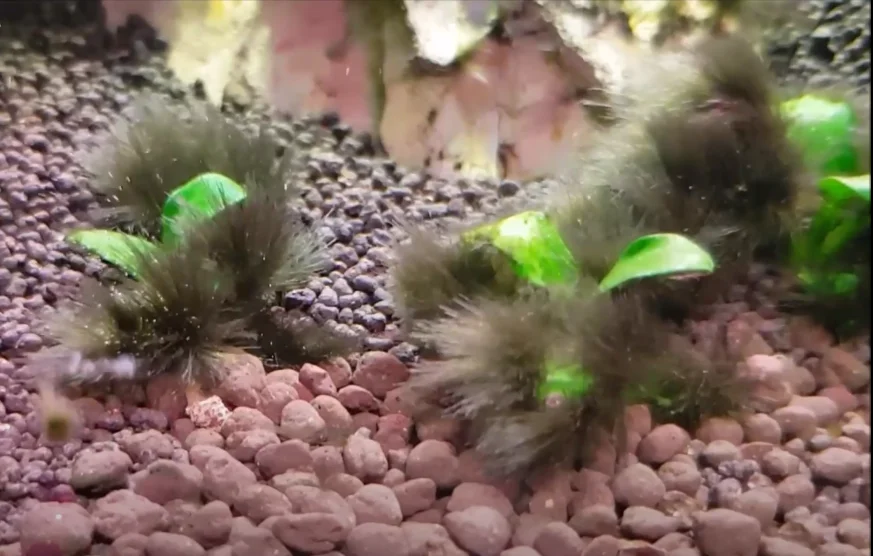
BBA
Black Beard Algae / Black Brush Algae (BBA)
Scientific name: Audouinella sp. (formerly Rhodochorton), Compsopogon sp. Taxonomic group: Rhodophyta (red algae) Water: Mainly fresh water Color: Black, dark gray, dark green, sometimes reddish or purple Texture: Soft, like a paintbrush or a strand of beard, very grippy
Appearance: Tufts or clumps of filaments ranging from 0.5 to 3 cm in length, black or very dark gray in color. Extremely firmly attached to substrates—it is very difficult to remove without damaging the surface. It appears mainly on the edges of leaves, decorations, and filter inlets. One of the most feared by aquarists.
Where does it appear?: Leaf edges (especially Anubias and Echinodorus), filter inlets, wooden and rock decorations, and glass in areas with current.
Is it dangerous?: It is not directly toxic, but it covers and smothers the leaves. It is very difficult to remove once it has become established. It drastically reduces the aesthetic value of the aquarium.
Related parameters:
- Inconsistent CO₂: This is the most commonly documented cause in planted aquariums. Fluctuations in CO₂ levels (sudden on/off cycles) stress the plants and benefit BBA.
- NH₄⁺: The presence of ammonium is a trigger
- PO₄: High levels may contribute to
- Current: Prefers areas with moderate to high current (filter outlet, pumps)
Main causes:
- Inconsistent CO₂ levels—the number one factor in planted tanks. pH fluctuations caused by CO₂ promote BBA.
- Residual ammonia (overfeeding, dead fish left in the tank, dirty filter)
- Elevated phosphate levels (> 2 ppm)
- Mature aquarium with a nutritional imbalance
- Introduction of new, unquarantined plants
How to remove it:
- Manual: Almost impossible without damaging the surface. You can try using a stiff brush on hard finishes.
- Biological:
- True Siamese Algae Eater (Crossocheilus oblongus, NOT the false SAE) — the only fish that effectively eats BBA
- Amano shrimp — they eat dead or weakened BBA, not live ones
- Florida Flagfish (Jordanella floridae) — eats BBA in cold aquariums
- CO₂ Treatment: Stabilize CO₂ levels using a timer and a high-quality diffuser. BBA often disappears on its own once CO₂ levels stabilize.
- Chemical (the most effective):
- Glutaraldehyde (Easy Carbo/Excel): Apply directly to the algae using a syringe; turn off the filter for 20–30 minutes. The BBA turns pink/red as it dies (the rhodophyte reveals its true pigment). Repeat for 2–3 days. Then the Amano shrimp will eat it.
- Hydrogen peroxide (H₂O₂ 3%): 5 mL/100 L with the filter turned off, or apply directly. Dead BBA turns red/white.
- Bicarbonate solution: Remove the affected decoration from the water and soak it in a 3% H₂O₂ solution for 3–5 minutes outside the aquarium. Very effective for removable decorations.
- Preventive quarantine: Soak new plants in a potassium permanganate solution (1 g/10 L, 10 min) before introducing them.
Prevention: Maintain a continuous and stable CO₂ level (do not turn it on or off abruptly), do not overfeed, use SAE in the aquarium, and quarantine new plants.