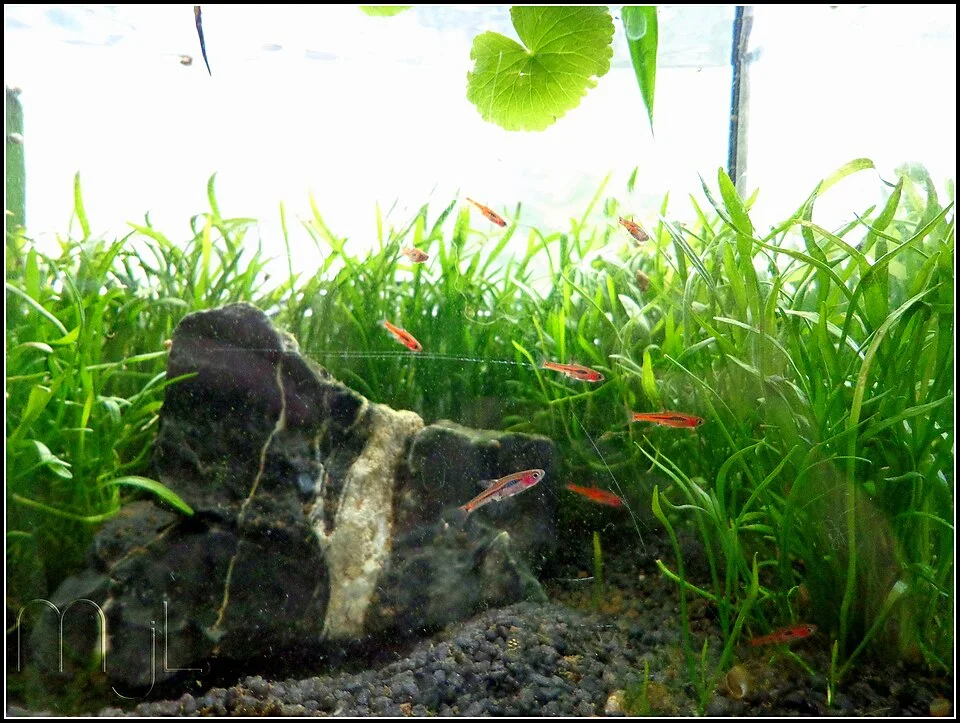
Nano Aquarium
1 topic in this section
Overall difficulty: ★★★★☆ (paradoxically harder than the big ones) Setup cost: low–medium Recommended minimum size: 10 L (for specific species) Who it's for: intermediate – advanced (NOT recommended for beginners)
Description
Aquariums smaller than 30 liters. Their main appeal is aesthetic and spatial: they fit anywhere. But they are much harder to keep stable than larger ones: any imbalance (the death of a fish, overfeeding) quickly affects the entire water column.
Why are nanos more difficult?
- Low chemical inertia: A dead fish contaminates 100% of the water within hours
- Unstable temperature: rises quickly in summer, drops quickly in winter
- More gradual water changes: Removing 2 L from a 10 L aquarium is 20% of the total volume
- Less room for error: every mistake has more immediate consequences
Common species
Water parameters (vary depending on the chosen fauna)
| Parameter | General Rank |
|---|---|
| Temperature | Depending on the species (18–28°C) |
| pH | Depending on the species (6.5–7.5 for most) |
| GH | Depending on the species (5–15 °dGH) |
| NH3 | 0 ppm (a tolerance even lower than in large aquariums) |
| NO2 | 0 ppm |
| NO3 | < 20 ppm (more stringent due to the small volume) |
Species specifically suited for nano tanks
| Species | Minimum liters | Notes |
|---|---|---|
| Cherry or Blue Velvet Shrimp | 10 L | Ideal for nano |
| Boraras brigittae (micro rasbora) | 20 L | Very small, 8+ bench |
| Trigonostigma espei | 20 L | Smaller than the harlequin |
| Danio margaritatus (Celestial Pearl) | 20 L | Beautiful, a little shy |
| Betta splendens (single) | 20-40 L | Alone, without a bench |
| Corydoras pygmaeus (dwarf) | 30 L | In groups of 6 or more, soft substrate |
| Nerite Snails | 10 L |
Nano equipment
- Small sponge filter or very small internal corner filter
- A mini heater—or no heater at all—if the room is warm
- Essential lid (high evaporation in small volumes)
- LED lighting specifically designed for nano tanks (Chihiros WRGB, ADA Mini)
- Small TDS and pH meter for frequent checks
Common Algae — What They Are, Why They Appear, and How to Get Rid of Them
A nano tank is the environment most prone to algae blooms due to chemical instability. Algae appear and spread more quickly than in large aquariums.
Diatoms
Behavior in nano tanks: They can cover the entire aquarium within a few days at first. This is very common. Solution: Otocinclus mini, 10% water changes daily. It will go away in 2–4 weeks.
GHA (Green Hair Algae)
Behavior in nano tanks: It spreads rapidly in nano tanks when exposed to light. Just one overfeeding can trigger a GHA boom. Solution: Reduce the photoperiod to 6 hours. Perform 20% water changes every 2–3 days. Amano shrimp (2–3 in a 20-liter nano tank).
Cyanobacteria
Behavior at the nanoscale: These are particularly dangerous at the nanoscale due to reduced circulation and higher concentrations of organic matter. Solution: Check the water circulation. Perform small water changes daily. Keep the tank completely dark for 3 days.
Most Common Mistakes
- Recommend Nano to beginners (it's the hardest setup to stabilize)
- Goldfish in a nano tank (completely incompatible)
- Medium-sized tropical fish in a nano tank (very stressed)
- Overfeeding: In a 10-liter tank, just one extra flake can raise ammonia levels
Key Tips
- The nano works well when the fish density is low and feeding is minimal
- Frequent water changes (10–20% every 2–3 days) are more important in nano tanks than in any other type
- Fast-growing plants (floating Salvinia, Elodea) are excellent at stabilizing water parameters
- Always have water prepared (at the same temperature, conditioned) and ready for emergency water changes
- The nano tank planted with cherry shrimp is the easiest and most visually appealing combination: highly recommended