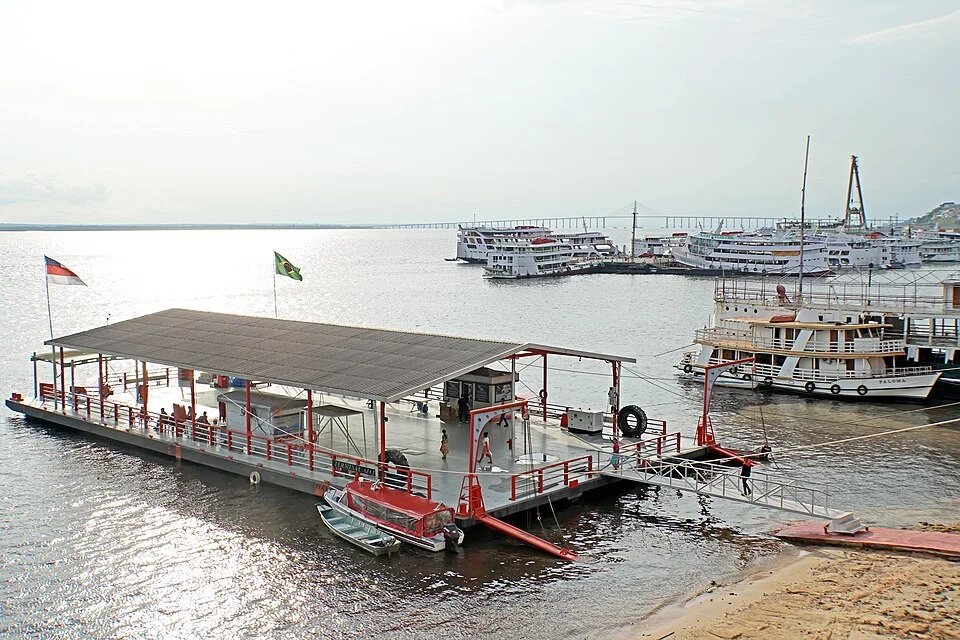
Black River
The river with the darkest water in the world. Low pH, almost no minerals, high temperature. A paradise for tetras and angelfish.
Description of the Natural Habitat
The Río Negro (a tributary of the Amazon) owes its dark color to tannins and humic acids leached from decaying vegetation. Its waters are extremely soft and acidic—almost as if distilled with organic acids. Visibility is low. The riverbed is covered with decaying leaves, roots, and submerged wood. Aquatic vegetation is scarce—there are hardly any floating plants.
Natural Water Parameters
| Parameter | Natural value |
|---|---|
| pH | 3.5 – 5.5 |
| GH | 0 – 1 °dGH |
| KH | 0 – 1 °dKH |
| Temperature | 26 – 30°C |
| Color | Dark brown ("tea") |
| TDS | < 20 ppm |
| Conductivity | < 10 µS/cm |
Recommended Aquarium Parameters
| Parameter | Aquarium Lens |
|---|---|
| pH | 4.5 – 6.0 |
| GH | 0–3 °dGH |
| KH | 0–2 °dKH |
| Temperature | 26 – 29°C |
| TDS | 50–100 ppm |
How to Achieve These Parameters
- Base water: Reverse osmosis (RO) + minimal mineralization
- Acidification and color: Catappa leaves (Terminalia catappa) — 1 leaf per 20 L; replace every 2–3 weeks
- Peat: Filter through acidic peat — it darkens and acidifies the water
- Wood: Mopani roots, spider wood — naturally release tannins
- Peat/blackwater extract: Products such as Sera Blackwater Aquatan, JBL Decarbo, Aquavitro Activate
Authentic Decor
- Substrate: Very fine quartz sand, preferably dark
- Wood: Multiple intertwined pieces of thin roots (spider root, Malaysian driftwood)
- Leaves: A layer of catappa leaves, oak leaves, and almond leaves—covering 60–70% of the bottom
- Seeds and pods: Terminalia pods, alder cones
- No rocks: The Río Negro is low in minerals; rocks would raise the pH
- Few or no submerged plants: Only floating plants (Salvinia, Pistia, Limnobium)
Lighting
Soft light, filtered through the canopy of vegetation. Low PAR (< 50 in the background). Warm- or neutral-spectrum bulbs—no cool-spectrum LEDs.
Native Species of the Río Negro
Fish:
| Species | Scientific name | Cape | Notes |
|---|---|---|---|
| Neon Cardinal | Paracheirodon axelrodi | Media | An Icon of Río Negro |
| Tetra Lemon | Hyphessobrycon pulchripinnis | Media | |
| Black Ghost Tetra | Hyphessobrycon megalopterus | Media | Long dorsal fin |
| Orange Pencil Fish | Nannostomus mortenthaleri | Media | Nanostomus spp. |
| Apistogramma agassizii | Apistogramma agassizii | Background | Dwarf, bright colors |
| Apistogramma cacatuoides | Apistogramma cacatuoides | Background | Fins like a crest |
| Altum (Scalar) | Pterophyllum altum | Media | Requires a very tall aquarium |
| Wild Discus | Symphysodon discus | Media | Only on mature systems |
| Corydoras adolfoi | Corydoras adolfoi | Background | Black and Orange Band |
| Corydoras duplicareus | Corydoras duplicareus | Background | Similar to C. adolfoi |
| Pencilfish | Nannostomus trifasciatus | Media | Horizontal at rest |
Floating plants:
- Salvinia natans / S. minima
- Pistia stratiotes (water lettuce)
- Limnobium laevigatum (water frog)
- Ceratopteris thalictroides (floating water fern)
Common Mistakes
- Add limestone (to raise the pH and hardness)
- Do not use RO water—tap water contains too many minerals
- Not enough catappa leaves — the water is too clear
- Overexposure — the Río Negro is dark
- Mixing fish that are not native to the Río Negro (e.g., danios, hardwater guppies)