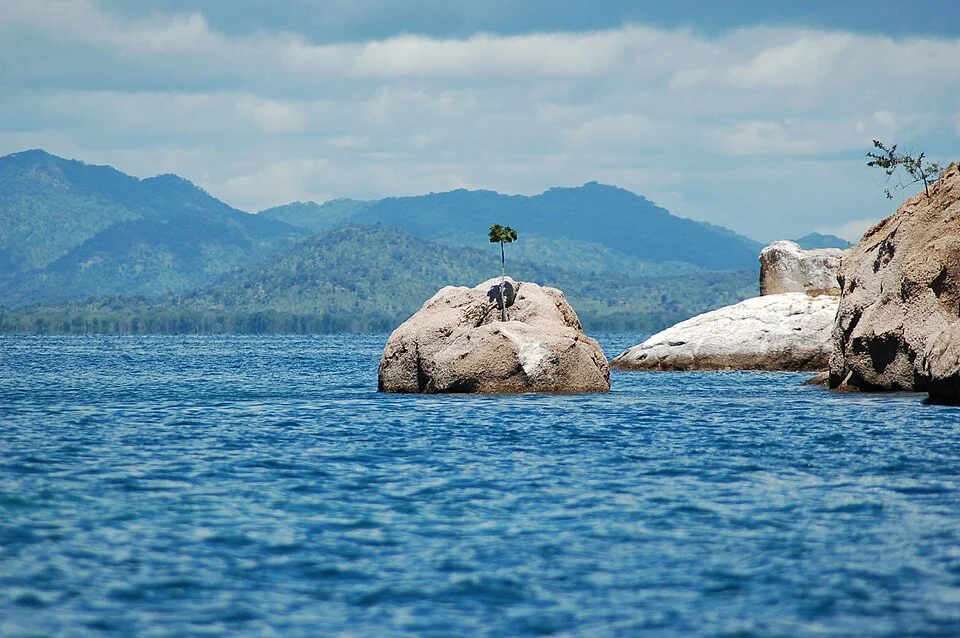
The "Mediterranean Sea" of cichlids. Very hard, alkaline water, with rocks and colorful reef cichlids.
Habitat Description
Lake Malawi is one of the oldest and deepest lakes in the world. Its waters are crystal-clear, alkaline, and very hard—with a pH close to 8.5. The shoreline is dominated by rocky outcrops (the habitat of the Mbunas) and sandy areas (the habitat of the Haplochromis and Aulonocara). There are no corals, but the colorful cichlids rival marine fish in their spectacular beauty.
Parameters
| Parameter | Natural value |
|---|
| pH | 7.8 – 8.5 |
| GH | 12–20 °dGH |
| KH | 8–15 °dKH |
| Temperature | 24 – 28°C |
| TDS | 200–250 ppm |
| Hardness | very hard |
Areas of the Lake and Their Inhabitants
Mbuna Zone (rocky shores)
| Species | Features |
|---|
| Maylandia zebra (zebra) | Multiple color morphs; strictly herbivorous |
| Pseudotropheus demasoni | Very aggressive; blue with black stripes |
| Labidochromis caeruleus (yellow) | Bright yellow; more tolerant |
| Melanochromis auratus | Sexual inversion: female yellow, male black |
| Pseudotropheus acei | Blue with a yellow dorsal fin and yellow tail; more peaceful |
| Cynotilapia afra | Blue with black stripes; dotted tail |
Sandy Area (Aulonocara / Peacock)
| Species | Features |
|---|
| Aulonocara stuartgranti | "Peacock" — a male with iridescent colors |
| Aulonocara nyassae | Cobalt blue |
| Aulonocara jacobfreibergi | Orange/red on the fins |
| Nimbochromis livingstonii | A predator that pretends to be dead |
Pelagic zone (Haplochromis)
| Species | Features |
|---|
| Copadichromis borleyi | Red-blue; school of fish in the middle zone |
| Protomelas taeniolatus | Several morphs per lake |
| Fossochromis rostratus | Elongated snout; sifts sand |
Authentic Decor
- Substrate: Fine white-beige sand (carbonate-free quartz sand)
- Rocks: Abundant, stacked to form rock reefs—slabs of slate, granite, or Malawi rock. No wood.
- No plants: Most of the lake is free of vegetation (except for Vallisneria in shallow areas)
- Structure: Many caves, crevices, and passageways for the females to hide in
Settlement Strategy
- Deliberately overstocking: 1 cichlid per 10 L to distribute aggression
- Harem ratio: 1 male to 3–5 females per species
- Introduce them all at once or in small batches: Never introduce a single male into an established system
Common Mistakes
- Mixing Mbunas with softwater fish (they are incompatible)
- Few rocks—the territorial male chases everyone away because there aren't enough areas
- Feeding herbivorous Mbunas a high-protein diet (causes "bloat"—fatal swelling)
- Insufficient filtration — these fish produce a lot of waste