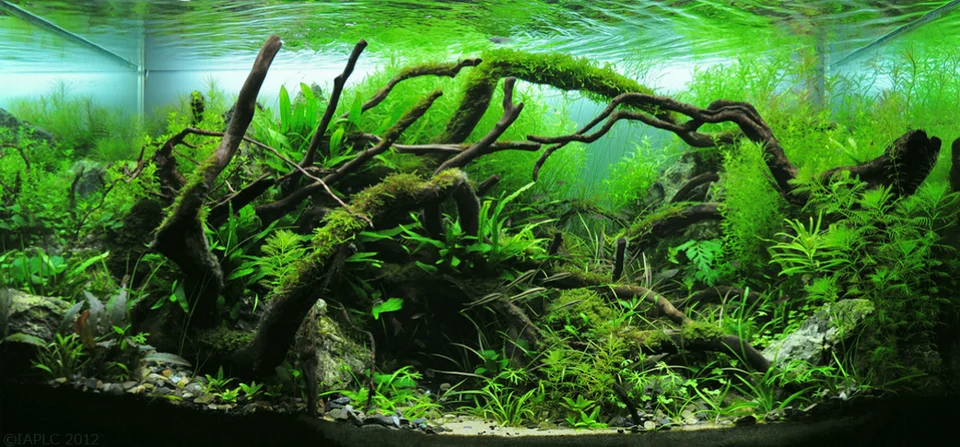
Planted Aquarium
1 topic in this section
Overall difficulty: ★★★☆☆ (basic) to ★★★★★ (advanced aquascaping) Setup cost: medium – very high Recommended minimum size: 60 L Who it's for: intermediate – advanced
Description
Live plants are the stars of the aquarium. The goal is to recreate an underwater garden where the plants grow healthy and lush. The fish are secondary: they are chosen to complement the design. This requires an understanding of photosynthesis, nutrients, and CO₂ chemistry.
Water Parameters
| Parameter | Basic setup (without CO2) | Advanced hydroponics (with CO2) |
|---|---|---|
| Temperature | 22 – 27°C | 22 – 26°C |
| pH | 6.5 – 7.5 | 6.0 – 7.0 (CO2 lowers it) |
| GH | 4–12 °dGH | 3–8 °dGH |
| KH | 3–8 °dKH | 3–6 °dKH |
| CO2 | — | 15–30 ppm |
| NO3 | 5–20 ppm | 10–25 ppm |
| PO4 | 0.1–1 ppm | 0.5 – 2 ppm |
| Faith | < 0.1 ppm | 0.05–0.1 ppm |
Required Equipment
| Equipment | Basic (without CO2) | Advanced (with CO2) |
|---|---|---|
| Filter | External (little surface movement) | External quality control; underwater output |
| Lighting | T5 or medium-sized LED (PAR 50–100) | High-Power LED (PAR 100–250+) |
| CO2 | — | Tank + regulator + diffuser + drop checker |
| Substrate | Inert or nutritious | Nutrient-rich (ADA Amazonia, Tropica Soil) |
| Fertilization | Weekly Basics | Daily Fertilization (EI or Dosage) |
| Heater | Yes | Yes |
Plant Species by Level
No CO2 / low light (easy): Anubias, Java ferns, Cryptocoryne, Java moss, Vallisneria, Sagittaria
With CO2 / medium light: Rotala rotundifolia, Ludwigia repens, Hygrophila, Echinodorus, Eleocharis
With CO2 / high light (advanced): HC Cuba, Glossostigma, Rotala macrandra, Fissidens, Eriocaulon
Recommended Fish
Tetras (Hemigrammus bleheri, Paracheirodon), rasboras, Otocinclus (essential for algae control), Corydoras, Amano shrimp (algae control), cherry shrimp (biofilm).
Common Algae — What They Are, Why They Appear, and How to Get Rid of Them
A planted aquarium has its own algae ecosystem. Algae serve as an indicator of imbalances. Each type of algae points to a different problem.
Brown Algae / Diatoms
When it appears: During the first 2–6 weeks of any new aquarium or after replacing the substrate. Why: Silicates in fresh water + low light + unstable biological filter. Solution: Wait. Otocinclus. Increase lighting moderately. It will go away on its own.
Green Dot Algae (GSA)
When it appears: In setups with intense light but low phosphate levels. Reason: PO4 < 0.05 ppm. The plants are growing slowly (due to a lack of phosphorus), and the GSA is taking advantage of the situation. Solution: Raise the PO4 level to 0.5–1 ppm. Use Nerite snails for the glass.
Black Algae BBA
When it appears: The most problematic issue in CO2-enriched setups. It appears on the edges of leaves, roots, and diffusers. Why this happens in CO2-injected hydroponics: CO2 levels fluctuate (it is injected in bursts rather than at a steady rate) → plants go from saturation to deficiency → the BBA takes advantage of the deficiency. Why in CO2-free planted tanks: Excess organic matter in the water. Solution:
- Stabilize CO2 → reduce the number of bubbles per second and keep it constant
- Ensure that CO2 is distributed properly (diffuser properly positioned, adequate flow)
- Add Easy Carbo directly to the BBA using a pipette (turn off circulation for 5–10 minutes)
- Add Amano shrimp in the appropriate amount (1 per 2–3 L)
- The cold-feeding Siamese (Crossocheilus oblongus) actively feeds on BBA
Filamentous Green Algae (GHA)
When it occurs: Common at the start of a planted tank or when there is an imbalance between nutrients and light. Why: Excess light relative to nutrients and plant growth. The plants do not "consume" enough, so the algae take over. Solution:
- Reduce the photoperiod to 6–7 hours for 2–3 weeks
- Amano shrimp (20–30 in a 100-liter aquarium during treatment)
- Fertilize properly so the plants can compete
- Reduce CO2 if it is too high (it can paradoxically cause GHA by making the water too acidic)
Cyanobacteria (Blue-Green Algae)
When it appears: In areas with little water movement, compacted substrate, and aquariums with low nitrate levels but high phosphate levels. Reason: N:P imbalance + stagnant water. The ideal ratio is ~10:1 (NO3:PO4). Solution:
- Increase water circulation and flow in the affected areas
- Physical Suction Using a Siphon
- Raise nitrate levels if they are too low (< 5 ppm): add nitrogen fertilizer
- Total darkness for 3–5 days
- Apply H₂O₂ directly to the blanket (turn off the filter for 30 minutes)
Beard Algae / Staghorn Algae (Compsopogon spp.)
Appearance: Branched filaments 1–5 cm long, gray-green or gray, resembling deer antlers. Reason for occurrence: Similar to BBA. Fluctuations in CO2 and high ammonia levels. Solution:
- Same protocol as BBA
- Easy Carbo Directly
- Amano Shrimp
- Improving CO2 Stability
"New Planting" Series: What to Expect Week by Week
| Week | What's going on? | What to Do |
|---|---|---|
| 1-2 | Diatoms everywhere. Plants are adapting (some are dying off—that's normal) | Do not intervene. Add Otocinclus. |
| 2-4 | The diatoms are gradually disappearing. Some GHA may appear. | Reduce the photoperiod to 7 hours if GHA is present |
| 4-8 | The plants are starting to grow. Equilibrio is improving. | Start fertilizing. Gradually increase the photoperiod. |
| 2–3 months | Stabilized aquarium. Plants are growing vigorously. | Standard Maintenance |
Most Common Mistakes
- Too much light from the start (causes an algal bloom)
- Unstable CO2 levels (fluctuating rather than constant): causes BBA
- Incorrect growing medium for the type of plant
- Do not fertilize columnar plants (which absorb nutrients from the water)
- Rinse the filter with tap water (this kills bacteria)
Key Tips
- Light stimulates growth, but it also promotes algae growth: start with a low setting (7 hours, 60% intensity) and gradually increase it
- Stable CO2 levels are more important than volume: a constant rate of 1 bubble per second is better than 3 bubbles per second with fluctuations
- Amano shrimp are the best defense against algae: always add them to planted tanks
- The "planted triangle" rule: light + CO2 + nutrients must be balanced. Increasing one without the others = algae