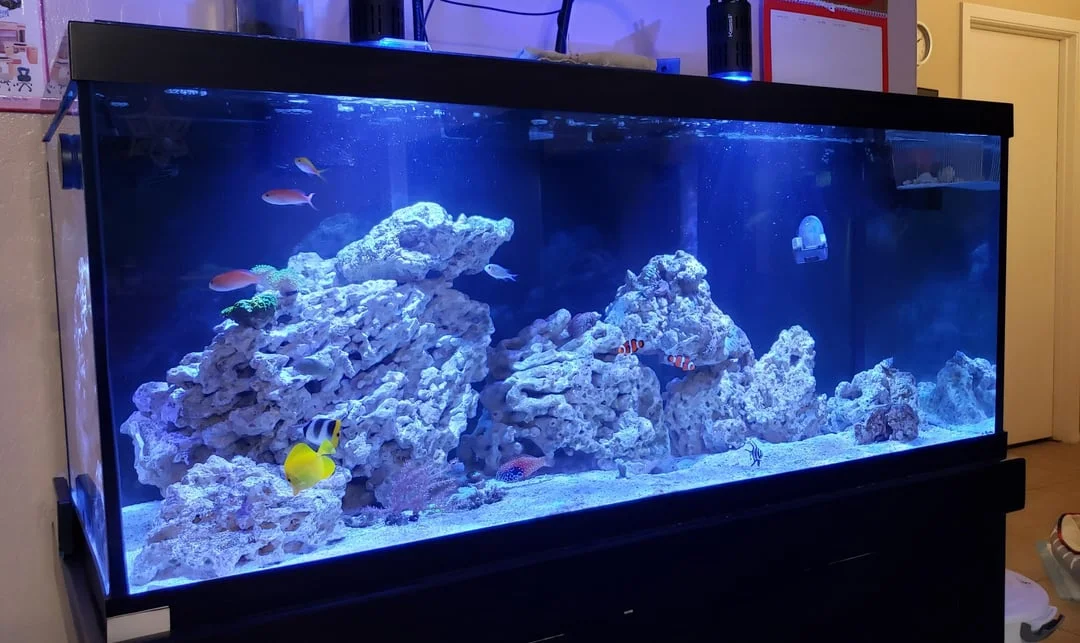
Marine Aquarium — FOWLR
1 topic in this section
Overall difficulty: ★★★☆☆ Setup cost: high Recommended minimum size: 200 L Who it's for: intermediate – advanced
Description
Fish Only With Live Rock: marine fish with live rock but without corals or delicate invertebrates. This is the entry point into marine aquariums. It is more forgiving in terms of water parameters than a reef tank and allows for larger, more colorful fish.
Water Parameters
| Parameter | Range |
|---|---|
| Temperature | 24 – 27°C |
| Density / Salinity | 1,020–1,025 / 27–35 ppt |
| pH | 8.0 – 8.4 |
| NH3 | 0 ppm |
| NO2 | 0 ppm |
| NO3 | < 30 ppm (more lenient than reef) |
| PO4 | < 0.5 ppm |
Required Equipment
| Equipment | Specifications |
|---|---|
| Filter | Protein skimmer + mechanical filtration |
| Live rock | 15–20 kg per 100 L (main biological filter) |
| Traffic | 10–20 times the volume per hour |
| Lighting | For aesthetic purposes only (basic marine LED or T8) |
| Heater | Titanium, corrosion-resistant |
| Refractometer | To monitor salinity daily |
Common species
Common Fauna in FOWLR Tanks
Clownfish, tangs, triggerfish, butterflyfish, pufferfish, large angelfish, groupers, lionfish. Many species that aren't reef-safe do very well in FOWLR tanks.
Common Algae — What They Are, Why They Appear, and How to Get Rid of Them
Algae are one of the biggest challenges for aquarists. The process of setting up a FOWLR tank involves very distinct algae phases.
Phase 1 — Diatoms (Weeks 1–4)
Appearance: Brown film on sand, rocks, and glass. Why: Silicates from fresh water and salinity. This is completely normal. Solution: Wait. Nassarius and Trochus snails will eat it. It will disappear on its own.
Phase 2 — Filamentous Green Algae (GHA) (Weeks 4–12)
Appearance: Green tufts on rocks and substrate. Reason: Excess nitrates and phosphates from the initial cycle. This is very common during the establishment phase. Solution:
- Skimmer working properly (reduces organic matter that feeds algae)
- Cleanup crew: Trochus snails + Nassarius snails + hermit crabs
- Regular Water Changes
Persistent Green-Haired Algae (Chronic GHA)
Why it persists: Chronically high nitrate or phosphate levels (overfeeding, infrequent water changes, insufficient skimmer). Solution:
- Increase the skimmer's capacity (or buy a more powerful one)
- Wrasse (Halichoeres chrysus, Yellow Surgeonfish)
- More Frequent Water Changes
- Review your diet (cut back)
- GFO (Phosphate) Reactor
Coraline Algae (CCA — Crustose Coralline Algae)
Appearance: Pink, purple, or red deposits on rocks and glass. Is it bad? NO. It's entirely beneficial: it indicates good water quality, competes with other algae, and enhances the appearance of the rocks. It's the goal of every well-established marine aquarium. How to encourage it:
- Maintain Ca > 380 ppm and KH > 8 dKH
- Water with good salinity and quality
- Proper lighting on the rocks
Dinoflagellates (Dinos)
Appearance: Viscous, yellowish-brown mucus with trapped O₂ bubbles. It covers the sand and rocks, forming a sticky film. It appears mainly in the mornings. Why: Nutrient imbalance (very low NO3 and PO4) + establishment phase. Dinosaurs can take advantage when there isn't enough competition from bacteria and other microorganisms. Is it dangerous? Some species of dinosaurs are toxic to fish and invertebrates. Solution (long process, 4–8 weeks):
- Total darkness for 3 days: drastically reduces the population
- Physically suction using a siphon every day
- Raise nitrate levels if they are too low (paradoxically: < 1 ppm favors dinoflagellates)
- Increase water circulation
- Add copepods (natural competition)
- Pasteurize the sand (in extreme cases)
- Amphipods and copepods: Introducing live fauna to the aquarium
Cyanobacteria (Marine Cyanobacteria)
Appearance: A blanket of deep red, reddish-brown, or orange color covering the sand and rocks. Why: Stagnant water in some areas of the bottom, high NO3 levels, excess organic matter. Solution: Improve circulation. Physically vacuum. Change the water. Keep the tank dark for 3 days. In severe cases, treat with erythromycin in quarantine (this damages the biological filter in the sump/live rock).
Quarantine in FOWLR — ESSENTIAL
All new fish must spend 4–6 weeks in quarantine before being added to the main aquarium:
- Detect marine ich (Cryptocaryon irritans) before it infects the system
- Ich can survive in the main aquarium without fish for 8–10 weeks
- A fishless aquarium ("fallout period") is the only way to eliminate ich from the main system
Most Common Mistakes
- Not quarantining: This introduces ich, which is then impossible to treat without draining the aquarium
- Skimmer too small for the size of the aquarium
- Not enough live rock (the biological filter isn't working)
- Overfeeding large fish (they produce a lot of waste)
Key Tips
- Quarantine isn't optional: it's the difference between a healthy system and a disaster caused by ich
- The skimmer is the heart of the system: invest in a high-quality one from the start
- Weekly water changes of 10–15% keep the parameters stable
- FOWLR is much more tolerant of water parameters than a reef tank, but that doesn't mean you can neglect it
- Start the cycle with live rock only; do not add fish until NH3 and NO2 = 0