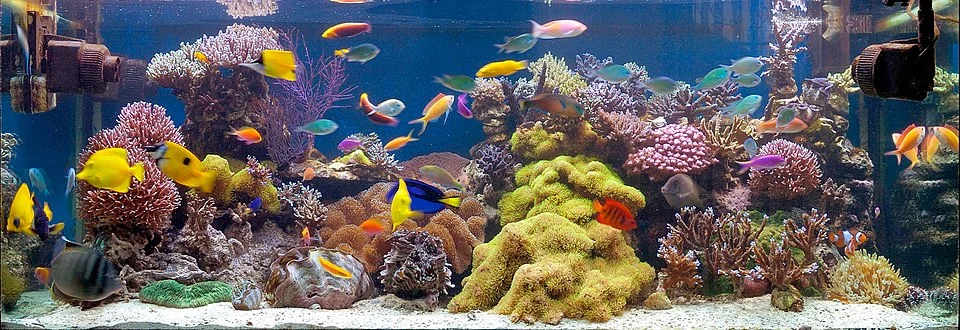
Marine aquarium — coral reef (reef)
1 topic in this section
Overall difficulty: ★★★☆☆ (soft corals and LPS) to ★★★★★ (predominantly SPS) Setup cost: very high Recommended minimum size: 150 L (soft corals/LPS) / 300 L (SPS) Who it's for: advanced – expert
Description
The most demanding, most expensive, and most spectacular aquarium in the entire hobby. Live corals take center stage. It requires a perfect balance of light, water flow, water chemistry, and parameters that mimic the natural ocean. The reward is an underwater ecosystem of extraordinary beauty.
Water Parameters (NSW — Natural Seawater)
| Parameter | Soft/LPS | Mixed LPS/SPS | Dominant SPS |
|---|---|---|---|
| Temperature | 23-27°C | 25-26°C | 25-26°C (±0.5°C) |
| pH | 8.1-8.4 | 8.2-8.4 | 8.2-8.4 |
| Salinity | 1.023-1.026 | 1.024-1.026 | 1.025-1.026 |
| Ca | 350+ ppm | 400–430 ppm | 420–450 ppm |
| KH (Alk) | 7–11 dKH | 8–10 dKH | 8–9 dKH |
| Mg | 1,200+ ppm | 1,250–1,350 ppm | 1,300–1,400 ppm |
| NO3 | < 20 ppm | < 5 ppm | 2–5 ppm |
| PO4 | < 0.1 ppm | < 0.05 ppm | 0.03–0.05 ppm |
Essential Reef Equipment
| Equipment | Purpose |
|---|---|
| High-quality skimmer (Nyos, Deltec, Bubble Magus) | Remove organic matter before it decomposes |
| High-flow circulation pumps (Tunze, Jebao) | Water flow for corals (20–40 times the volume per hour) |
| High-quality LED/T5 lighting (Radion, AI Hydra, Kessil) | Photosynthesis in zooxanthellae; precise PAR |
| Sump + shelter with macroalgae | Filtration, stability, copepods |
| ATO (Auto Top Off) | Automatically replenish evaporation |
| Dosing Pump + Balling System (GHL, Kamoer) | Precisely and automatically replenish Ca, KH, and Mg |
| Reef controller (Apex, GHL) | Comprehensive Monitoring and Automation |
| High-Quality Refractometer (ATC) | Daily Salinity |
| Complete test kits (Hanna Colorimeter, Salifert) | Weekly testing of Ca, KH, Mg, NO3, and PO4 |
Common Algae — What They Are, Why They Appear, and How to Get Rid of Them
On the reef, algae are one of the biggest challenges and one of the most accurate indicators of the system's health.
Establishment Phase (first 8–16 weeks)
Every new reef goes through phases of algae growth before it stabilizes. This is normal and necessary.
Weeks 1–4: Diatoms A brown film over everything. Normal. Nassarius and Trochus keep it under control. It goes away on its own.
Weeks 4–8: GHA (Green Hair Algae) Green patches on rocks and glass. A sign that NO3 and PO4 levels from the initial cycle are high.
- Improving the skimmer
- Cleanup crew: Trochus, Nassarius, hermit crabs, emerald crab
- Algae-removing blades
Weeks 6–12: Dinoflagellates (Dinos) The most feared enemy of the new reef. Sticky brownish-yellow slime on the sand. (See the full protocol section below)
Weeks 12–24: Coralina Algae (CCA) The appearance of pinkish-purple CCA on the rocks means that the reef is establishing itself properly. Welcome.
Bryopsis (Green Featherweed)
Appearance: Green filamentous algae with feather-like branches, 2–8 cm long. Very difficult to remove. Why: It appears when other controls fail; it is resistant to most treatments. Solution:
- Fluconazole (antifungal): the only proven treatment. Precise dosage in circulating water. May affect invertebrates; use with caution and proper preparation.
- Labros (Halichoeres, Pseudocheilinus hexataenia): They eat some Bryopsis
- Thorough manual removal
Cyanobacteria (Red Marine Cyanobacteria)
Why in a reef tank: High NO3, unbalanced PO4, poor circulation. Solution:
- Improve circulation (Gyre pumps are excellent for eliminating dead zones)
- Reduce food intake
- Active macroalgae shelter (absorbs NO3 and PO4)
- More Frequent Water Changes
Dinoflagellates (Dinos) — The biggest problem facing the reef
Appearance: Viscous brownish-yellow mucus, sometimes with bubbles. It appears at night or in the early morning and partially dissolves in daylight. It covers the sand and the bases of the corals. Why: Multiple causes: a new system with no established competition; very low NO3 and PO4 levels (paradoxical); water that is "too clean" and lacks a diverse bacterial population. Complete disposal protocol:
- Identify the type of dino (microscopic if possible: Ostreopsis and Amphidinium are the most toxic)
- Increase NO3 to 5–10 ppm and PO4 to 0.05–0.1 ppm if they are very low
- Total darkness for 3–5 days (cover the aquarium completely)
- Physically use a siphon to remove debris every morning before turning on the light
- Inoculating copepods and amphipods (Tisbe, Tigriopus): biological competition
- Increase bottom circulation (dinosaurs are benthic)
- Patience: It may take 6–12 weeks to fully get under control
"New Tank Syndrome" in marine life
The first 6–12 months of a reef tank are the most unstable. It’s normal to experience algae blooms, fluctuations in water parameters, and difficulties getting the tank established. Patience is the most important virtue when it comes to reef tanks.
Most Common Mistakes
- Add corals before the system is stabilized (at least 3–6 months for LPS; 12+ months for SPS)
- Do not quarantine the fish (this introduces ich, which spreads throughout the entire system)
- Do not add Ca/KH/Mg when the corals' consumption exceeds the amount removed during water changes
- Unstable parameters (worse than slightly low but stable parameters)
- Skimmer is insufficient for the system's volume
Key Tips
- The stability of the parameters is more important than their exact values
- Start with soft corals and easy LPS (Zoanthus, Mushrooms, Hammers) before trying SPS
- A refuge with Chaetomorpha or Caulerpa taxifolia is the best natural method for reducing NO3 and PO4
- Always have seawater on hand for emergency water changes
- Record all parameters weekly to identify trends before they cause problems