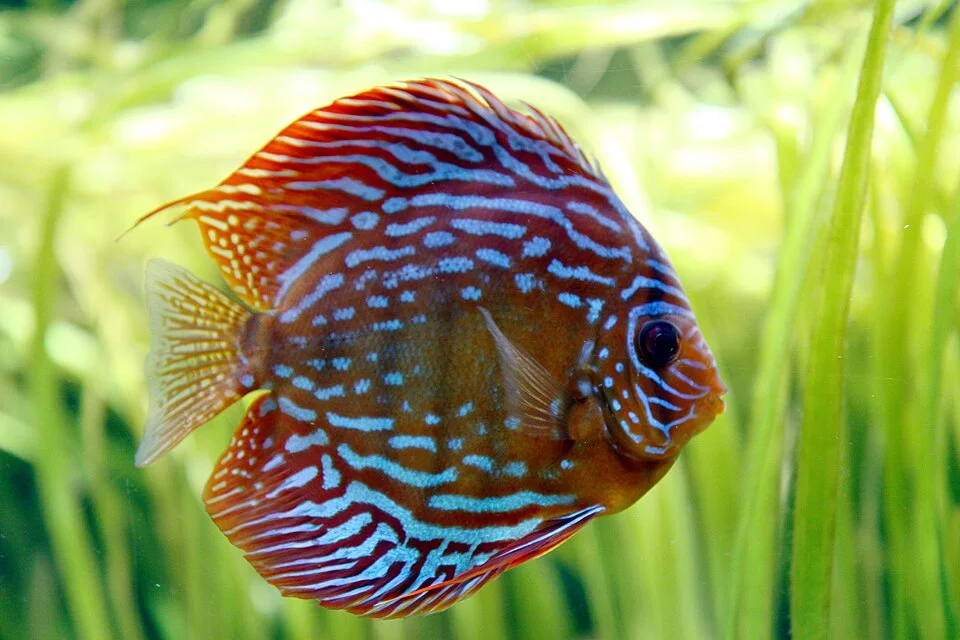
Discus Fish Tank
1 topic in this section
Overall difficulty: ★★★★★ Setup cost: high – very high Recommended minimum size: 250 L (tall, at least 50 cm high) Who it's for: Experts with prior experience with cichlids
Description
The Most Demanding Freshwater Aquarium. The Discus (Symphysodon spp.) is the “king” of the tropical aquarium: an extraordinarily beautiful fish with complex social behavior and fry that feed on their parents’ own mucus. It requires soft, highly acidic, and warm water, with frequent water changes and high water quality standards.
Water Parameters
| Parameter | Range |
|---|---|
| Temperature | 28 – 32°C |
| pH | 5.5 – 6.8 |
| GH | 0–6 °dGH |
| KH | 0–3 °dKH |
| NH3 | 0 ppm (zero tolerance) |
| NO2 | 0 ppm |
| NO3 | < 10 ppm (ideally < 5) |
Required Equipment
- Powerful external filter (Eheim Pro, Fluval) + prefilter for organic matter
- Reliable titanium heater (dual heater recommended for safety)
- Reverse osmosis system (not compatible with hard water)
- UV Sterilizer (reduces pathogens in warm water)
- Standalone Digital Thermometer
- Dark, fine sand substrate (reduces stress; the dark background enhances colors)
Water Change Protocol
- 30% at least every 2–3 days
- Many breeders do 50% daily
- The new water must be at the SAME temperature (temperature shock is lethal)
- Use RODI water that has been remineralized with minerals for soft water
Compatible partners
Few fish can tolerate 30°C: Corydoras sterbai (the only Corydoras that can withstand that temperature), Ancistrus, and cardinal tetras (if the pH is suitable). Freshwater loaches (Botia) CANNOT tolerate these temperatures.
Common Algae — What They Are, Why They Appear, and How to Get Rid of Them
High temperatures and soft, acidic water create an environment in which algae behave somewhat differently.
Brown Algae / Diatoms
Behavior in Discus: It appears as it does in any new aquarium but tends to persist longer in very soft, acidic water (nitrifying bacteria also establish themselves more slowly). Frequent water changes control it well. Solution: Otocinclus, water changes, and regular glass cleaning.
Cyanobacteria
Discus Behavior: Common in this type of aquarium due to high levels of organic matter (discus are messy, and eating a lot is essential). High temperatures promote their proliferation. Solution: Increase water circulation. Change the water more frequently. Thoroughly vacuum the bottom of the tank during each water change. Reduce feeding.
GHA (Green Hair Algae)
Behavior in Discus: If it appears, it spreads rapidly under high light and temperature conditions. Discus are not algae eaters. Solution: Reduce the photoperiod. Introduce Otocinclus or Amano shrimp if the temperature allows.
Diseases Related to Water Quality
- Body darkening: first sign of stress (high NO3, temperature change, new fish)
- HLLE: hole in the head — nutritional deficiency + poor water quality + Hexamita
- Head fluke (Hexamita): very common in discus; treatment with metronidazole
Most Common Mistakes
- Untreated tap water (must be treated with RODI)
- High NO3 (they have very low tolerance for nitrates; < 10 ppm is key)
- Temperature too low (< 28°C causes immune system problems)
- Overcrowding the aquarium (they get dirty; keep fewer fish than you might think is possible)
- Mixing with fish that are incompatible in terms of temperature
Key Tips
- The Discus is the fish that causes the most stress for aquarists: it's only for people with a lot of experience and time
- A plant-free discus aquarium is easier to maintain (it makes frequent water changes easier)
- Buy captive-bred discus: they are hardier and better adapted to treated tap water
- Water changes are more important than any other aspect of maintenance
- Always keep a separate digital thermometer on hand to detect heater malfunctions