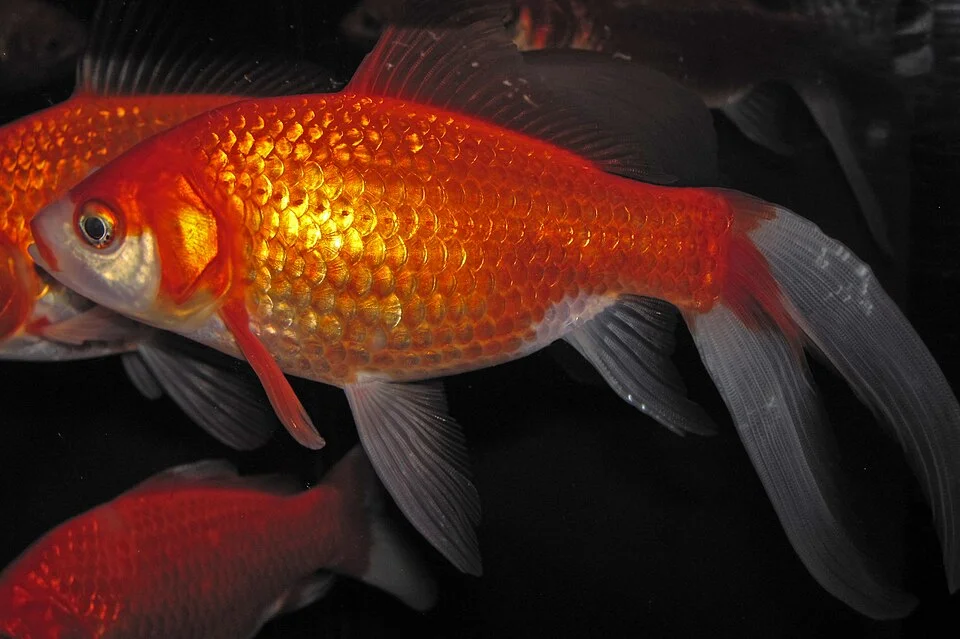
Cold-water goldfish aquarium
1 topic in this section
Overall difficulty: ★★☆☆☆ Setup cost: low–medium Recommended minimum size: 80 L per fish (round-bodied goldfish), 120 L per fish (comet, shubunkin) Who it's for: Beginner–intermediate (easy to maintain but requires space and powerful filtration)
Description
Cold-water fish, primarily goldfish (Carassius auratus) and koi (Cyprinus rubrofuscus), are the most commonly kept fish in the world. They are hardy but produce large amounts of waste: they require large aquariums and very powerful filtration. They are incompatible with tropical fish.
Water Parameters
| Parameter | Range |
|---|---|
| Temperature | 10–22°C (without a heater in temperate climates) |
| pH | 7.0 – 8.0 |
| GH | 8–20 °dGH |
| KH | 5–12 °dKH |
| NH3 | 0 ppm |
| NO3 | < 40 ppm |
Types of Goldfish and Their Needs
| Type | Body | Mini Aquarium | Temperature |
|---|---|---|---|
| Cometail / Common | Long, fast | 120 L per fish | 10-20°C |
| Shubunkin | Elongated, speckled | 120 L/piece | 10-20°C |
| Fantail / Ryukin | Rounded | 80 L/piece | 15-22°C |
| Oranda / Ranchu / Lionhead | Very well-rounded | 80 L/piece | 16-22°C |
| Telescope Eye (Black Moor) | Bulging eyes | 80 L/piece | 16-22°C |
Golden rule: Round-bodied goldfish (fancy goldfish) are slow and clumsy swimmers; DO NOT mix them with elongated goldfish (which swim fast and will eat all their food).
Required Equipment
| Equipment | Specifications |
|---|---|
| Filter | Powerful outdoor or indoor unit; 8–10x the volume per hour |
| Lighting | Basic LED; 8–10 hours per day |
| Thermometer | Independent Digital |
| Substrate | Coarse gravel or coarse sand (goldfish dig) |
| Decor | Rocks, roots; hardy or artificial plants |
Note on filtration: Goldfish produce 3–5 times more waste than tropical fish of the same size. Without proper filtration → ammonia spikes → death.
Plants in a goldfish aquarium
Challenging: Goldfish eat almost all plants. Hardy options:
- Anubias (sturdy leaves; fish don't usually eat them)
- Vallisneria (it grows as fast as they eat it)
- Java moss (they eat it, but only as a dietary supplement)
- Alternative: Well-made plastic plants
Common Algae — What They Are, Why They Appear, and How to Get Rid of Them
Brown Algae / Diatoms
Behavior: Just like in other aquariums: it appears within the first few months. The goldfish themselves nibble at it on the glass and decorations with some enthusiasm. Solution: Wait. The goldfish themselves are partially in control of it.
Green Hair Algae (GHA)
Behavior: Due to the high nutrient load from goldfish, GHA can proliferate rapidly, especially in the presence of light. Solution:
- Reduce the photoperiod (8 hours maximum)
- Nerite snails (for the glass; goldfish can't eat them easily)
- More Frequent Water Changes to Lower NO3
- Avoid direct sunlight on the aquarium
Green Algae Bloom
Behavior: Very common in outdoor goldfish tanks (ponds) and in tanks exposed to direct sunlight. The water turns green due to single-celled algae. Fun fact: In outdoor ponds, "green water" is harmless to fish (goldfish even eat it as a supplement). In indoor aquariums, however, it is undesirable. Solution:
- UV Sterilizer (the best method)
- Keep the aquarium out of direct sunlight
- Water changes + floating plants that compete for nutrients
Cyanobacteria
Behavior: Common due to high nitrate levels and organic load. Lower water temperatures slow their growth but do not stop it. Solution: Improve filtration, thoroughly vacuum the bottom, and improve circulation.
Most Common Mistakes
- Aquarium too small (the most common mistake): fancy goldfish need at least 80L PER FISH
- Mixing goldfish with tropical fish (incompatible in terms of temperature)
- Insufficient filtration for the organic load from the goldfish
- Overeating (they're voracious eaters who always seem to be hungry)
- Using very soft or acidic water (they prefer hard, alkaline water)
Key Tips
- More space is always better: the more liters per fish, the healthier it will be
- Filtration is more critical than in any other type of freshwater aquarium
- Round-bodied (fancy) goldfish are more delicate than elongated-bodied ones
- It's better to feed small amounts several times a day than one large amount
- Check ammonia and nitrite levels weekly during the first few months